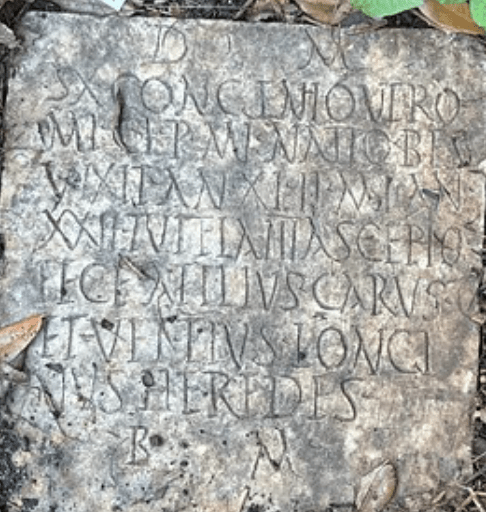
A US anthropologist from Tulane University has dug up a missing Roman artefact while digging in her back yard.
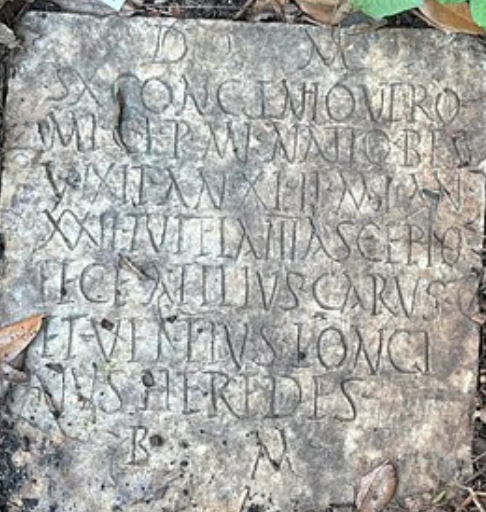
Daniella Santoro and her husband were clearing up the yard when the tablet emerged. It was originally discovered in the 1860s in Civitavecchia – an ancient Roman coastal town 30 miles from Rome. The Latin inscription on the gravestone reveals that it was dedicated to a Roman sailor, Sextus Congenius Verus, and is part of a collection gravestones from an ancient Roman cemetery in which approximately 20 military personnel were buried. The tablet is thought to date from between AD 100 to AD 200.
The couple were put in touch with Associate Professor of classical studies, Susann S. Lusni, also from Tulane University, who authenticated the find.
The tablet says that Sextus Congenius Verus served in the imperial navy, on a ship named after the Greco-Roman god of medicine, Asclepius. The inscription adds that Sextus was ‘well deserving’. It reveals that the tablet was commissioned as a memorial by two ‘heirs’ – these may be fellow sailors rather than family members, given members of Roman military personnel were at that time prohibited from marrying.
The last-known location of the tablet was at the National Archeological Museum in Civitavecchia before the start of World War II. It went missing after the Allies bombed the museum and has not been heard of since then.
The previous owner of the house where it was found, Erin Scott O’Brian, said that her grandparents had given it to her. Her grandmother was Italian and her grandfather was from New Orleans, but was stationed in Italy during the war. She added that her husband had used it as garden ornament, but they had left it behind when they sold the house.
Prof Lusnia said that it was likely to have been taken from the museum and brought to the US after the war – the tablet is currently in the possession of the FBI’s art crime unit.
She added that the sailor would have been ‘thrilled’ at the rediscovery of the tablet, as grave markers were important in ancient Roman culture and upheld an individual’s legacy.
‘If there’s an afterlife and he’s in it and he knows, he’s very happy because this is what a Roman wants — to be remembered forever,’ said Prof Lusnia.

Trajan’s voyage (scene LXXIX)
Two compact liburnians used by the Romans in the campaigns against the Dacians in the early 2nd century AD; relief from Trajan’s Column, c. 113 AD Attrib Apollodorus of Damascus / Conrad Cichorius – Conrad Cichorius (1863-1932)
The FBI is currently in discussion with the Italian government regarding the artefact’s repatriation, according to the 1970 UNESCO treaty, which encourages the return of stolen artefacts to their place of origin in cases of theft.
The FBI is currently in discussion with the Italian government regarding the artefact’s repatriation. according to the 1970 UNESCO treaty, which encourages the return of stolen artefacts to their place of origin in cases of theft.
 novelromealone
Fascinating!
LikeLike