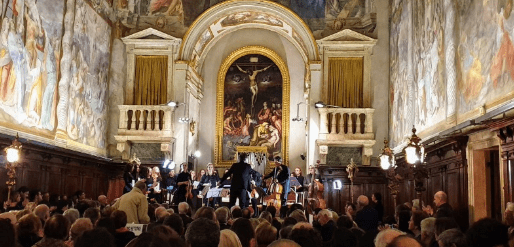
If you are currently visiting Rome and are looking for something to do on Thursday 8 May – VE Day – there is an evening concert of classical music at the Oratorio del Gonfalone, which is situated at Via del Gonfalone 32 near the Lungotevere main road that borders the River Tiber and quite close to Campo de’ Fiori.
The programme is below in Italian – and further down, in English, if you scroll past the Italian. I have also added some useful info if you have never been to a classical concert before, or one inside a church.
Informazioni scritte in Italiano
Orchestra da camera del Gonfalone -Romolo Balzani, direttore
Concerti grossi italiani – I suoni dell’Italia barocca
Oratorio del Gonfalone: info@oratoriogonfalone.eu
ORATORIO DEL GONFALONE STAGIONE CONCERTISTICA 2024/2025
Giovedì 08 Maggio 2025 ore 20:30 Turno A
BIGLIETTI AL BOTTEGHINO dalle ore 19:30 Prenotazione: info@oratoriogonfalone.eu
Settore I € 25
Settore II € 20
Orchestra da camera del Gonfalone Romolo Balzani
direttore
Concerti grossi italiani –
I suoni dell’Italia barocca
A. Vivaldi
Concerto in Si bemolle Maggiore per archi RV 163 Allegro molto moderato, Andante, Allegro
C. Tessarini
Overture – La Stavaganza op 4 Allegro assai, Largo sempre piano, Presto
G.B. Sammartini – ricorrenza 250 anni della morte)
Sinfonia in Sol Maggiore per archi Allegro ma non tanto, Grave, Allegro assai, Minuetto
A. Vivaldi
Concerto in Re minore RV 128, Allegro non molto, Largo
D. Scarlatti – C. Avison
Concerto Grosso in Re Maggiore n. 6 Largo Con Furio, Adagio, Vivacemente
A. Vivaldi
Concerto in do minore per archi RV 119 Allegro, Largo, Allegro
ORCHESTRA DA CAMERA DEL GONFALONE
L’Orchestra da Camera del Gonfalone, oggi considerata il fiore all’occhiello della stagione concertistica del Gonfalone, è stata ricreata nel 2020 per volontà del direttore artistico Romolo Balzani, con l’intento di dare nuova vita a una storica realtà musicale. L’orchestra aveva già conosciuto una significativa attività negli anni ’70 e ’80, sotto la direzione artistica di Gastone Tosato, prima di attraversare un lungo periodo di inattività. La nuova formazione nasce con l’obiettivo di unire le competenze, la formazione e le esperienze artistiche dei suoi componenti in un ensemble dinamico e coeso, capace di affrontare con rigore e vitalità un ampio repertorio cameristico. I musicisti che la compongono vantano una solida attività concertistica e didattica sia in Italia che all’estero, e provengono da alcune delle più prestigiose istituzioni musicali del Paese: l’Orchestra dell’Accademia Nazionale di Santa Cecilia di Roma, l’Accademia Filarmonica della Scala, l’Orchestra Verdi e I Pomeriggi Musicali di Milano, l’Orchestra Sinfonica di Roma, l’Orchestra Toscanini di Parma, l’Orchestra Sinfonica della RAI di Roma e Torino, il Teatro dell’Opera di Roma, l’Orchestra di Roma e del Lazio, l’Istituzione Sinfonica Abruzzese. Ciascun musicista si è perfezionato con grandi maestri quali M. Cervera, G. Carmignola, A. Bonucci, E. Dindo, P. N. Masi, il Quartetto Amadeus e molti altri. Hanno inciso individualmente per etichette come Edizioni Bongiovanni, Stradivarius e Bam Music International, e si sono distinti in numerosi concorsi nazionali e internazionali, tra cui “Isola di Capri” e “Città di Moncalieri”. Dal 2022, l’orchestra si arricchisce di nuove energie grazie all’inserimento di giovani talenti selezionati attraverso audizioni pubbliche.
Progetti artistici
Sotto la direzione di Romolo Balzani, l’Orchestra da Camera del Gonfalone ha recentemente completato l’importante progetto dell’integrale dei Concerti Grossi di Giovanni Lorenzo Gregori, raccogliendo grande interesse da parte del pubblico e della critica. Attualmente è impegnata in due rilevanti iniziative artistiche:
Il progetto dedicato ai Concerti Grossi di Charles Avison, realizzati a partire dalle sonate di Domenico Scarlatti, che Avison trascrisse e rielaborò per orchestra, offrendo una raffinata fusione tra stile italiano e sensibilità britannica.
Il più ampio progetto sui Concerti Grossi italiani del periodo barocco, che mira a valorizzare e riscoprire pagine meno frequentate del repertorio barocco nazionale.
Queste iniziative confermano l’Orchestra da Camera del Gonfalone come realtà viva e attenta alla ricerca musicale, capace di coniugare rigore filologico e creatività interpretativa.
ORATORIO DEL GONFALONE: UNA LUNGA STORIA DI ARTE E FEDE
Per la Stagione Concertistica 2024-2025, esploreremo la straordinaria storia del Giubileo, un evento che va oltre i confini della cristianità per attirare l’attenzione di tutto il mondo su Roma. Il legame secolare tra la Confraternita del Gonfalone, il suo Oratorio e il tema del pellegrinaggio è radicato in tradizioni millenarie, offrendo un affascinante viaggio attraverso i secoli. In questo percorso storico e culturale, scopriremo preziose testimonianze storiche e artistiche che raccontano l’intreccio tra fede, arte e spiritualità. Un’occasione unica per addentrarci nelle atmosfere e nei simboli che hanno accompagnato generazioni di pellegrini.
IL GIUBILEO NELL’ARTE DELL’OTTOCENTO
Nell’Ottocento, i Giubilei rappresentarono momenti di profonda trasformazione per l’arte sacra, riflettendo le tensioni tra tradizione e modernità, fede e politica, spiritualità e rappresentazione visiva. In un secolo segnato da rivoluzioni, restaurazioni e dalla progressiva perdita del potere temporale della Chiesa, le celebrazioni giubilari assunsero un ruolo simbolico cruciale, influenzando significativamente la produzione artistica. Il XIX secolo vide la Chiesa affrontare sfide senza precedenti: dalla Rivoluzione Francese alla nascita degli stati nazionali, culminando con la presa di Roma nel 1870. In questo clima, i Giubilei divennero occasioni per riaffermare l’autorità spirituale del papato. Tuttavia, le celebrazioni giubilari dell’Ottocento furono spesso segnate da difficoltà: il Giubileo del 1825 fu poco partecipato, quello del 1850 non si tenne a causa delle instabilità politiche, e quello del 1875 avvenne in un contesto di isolamento della Chiesa dopo la perdita del potere temporale. Nonostante le difficoltà, i Giubilei dell’Ottocento lasciarono tracce significative nell’architettura e nell’urbanistica di Roma. Si registrarono restauri e abbellimenti di chiese, basiliche e vie processionali, con l’obiettivo di accogliere i pellegrini e riaffermare la centralità della fede. Questi interventi, sebbene meno grandiosi rispetto ai secoli precedenti, contribuirono comunque a modellare l’aspetto della città eterna. La pittura giubilare dell’Ottocento si caratterizzò per un ritorno a temi devozionali, con rappresentazioni di santi, martiri e scene bibliche. Artisti come Luigi Bisi e Tommaso Minardi si distinsero per opere che univano rigore accademico e fervore religioso. Inoltre, si sviluppò un’iconografia specifica legata ai Giubilei, con simboli come la Porta Santa, la croce e il pellegrino, che divennero elementi ricorrenti nelle opere d’arte dell’epoca. La scultura giubilare dell’Ottocento rifletté la tensione tra classicismo e nuove sensibilità artistiche. Si realizzarono statue di santi, altari e arredi liturgici che combinavano tradizione e innovazione. L’arte decorativa, in particolare, vide la produzione di oggetti liturgici e souvenir per i pellegrini, spesso realizzati con materiali a valorizzare e riscoprire pagine meno frequentate del repertorio barocco nazionale.
Queste iniziative confermano l’Orchestra da Camera del Gonfalone come realtà viva e attenta alla ricerca musicale, capace di coniugare rigore filologico e creatività interpretativa.
Copyright © 2025 Oratorio del Gonfalone, All rights reserved. Ricevi questa email perché sei registrato nel nostro sito
_________________________________________________________________
English Translation of Italian
Thursday, 8 May, 2025 at 8.30pm
TICKETS AT THE BOX OFFICE from 7:30 pm Reservation needed
Section 1 € 25
Section 2 € 20
info@oratoriogonfalone.eu
Gonfalone Chamber Orchestra
Romolo Balzani
Conductor
Major Italian works from the Baroque period
Antonio Vivaldi
Concert for strings in B flat major op. 12 RV 163 – Allegro molto moderato (moderately fast), Andante (slow), Allegro (fast)
Carlo Tessarini
Overture – La Stravaganza op 4 – Allegro assai (lively), Largo sempre piano (slow, gradual, quiet), Presto (very fast)
Giovanni Battista Sammartini – marking 250th anniversary of the death of the composer
Symphony in G Major for strings – Allegro ma non tanto (upbeat-ish), Grave (slow), Assai allegro (quite fast), Minuetto (stately)
Antonio Vivaldi
Concerto in D minor RV 128 – Allegro non molto (not too fast), Largo (slow)
Domenico Scarlatti – Charles Avison
Concerto Grosso in D Major No. 6 – Largo Con Furio (furious), Adagio (slow), Vivacemente (lively)
Antonio Vivaldi
Concerto RV 119 in C minor – Allegro (upbeat), Largo (slow), Allegro (upbeat)
Advice for audience members
Churches can be chilly even in summer, so take a stole, cardigan, sweatshirt, or a jacket to wear. They are also very echoey, so every whisper from the audience can be heard – coughs and sneezes sound like canon fire. I always take some water and cough sweets like mentholyptus or even chew some gum to minimise coughs and tickley throat syndrome. If you have a really bad coughing attack, best to quietly leave until it passes. The churches will have public loos inside so make sure you visit before the concert begins. There may be some refreshments at the interval, if there is one. Shorter concerts do not have an interval so prepared for that. It looks as though this one will have an interval, given the number of works – you can usually buy or are given a programme with your ticket.
If you have not been to a classical concert before, every work is usually in three or four “movements” which are at different speeds and evoke different moods. It is not normal to applaud between the movements as this is thought to break the overall mood of the piece – the works on the programme are divided up by composer. Sometimes applause does break out, however. If the soloist does a backflip in the middle of a violin concerto, obviously you want to show your appreciation, but generally people wait until all the movements have been played, often leaving an awkward silence and some shuffling between them. This is normal. Talking between movements is discouraged unless you notice a fire in the gallery.
Sometimes conductors and even some of the musicians can interact with the audience in small venues, especially when things do not go to plan – it is okay to giggle at anything that goes wrong, such as a baton flying out of their hand, or a music stand that falls over, but only if everyone else is laughing. If the conductor turns to the audience for moral support with their eyes raised to heaven, follow what the crowd does in response. We’ve all been there at work.
What to wear: Layers. It will be warm in May in Rome, but could be rainy, so light outer clothes, a jacket and raincoat in case you find it is pouring when you leave. People do not usually dress up in evening wear unless it is a special occasion like a gala – even at La Scala in Milan there are a lot of disappointing sweater wearers sitting in the front stalls, usually clutching copies of the score and following it avidly during the performance, just in case someone misses a note or an arpeggio goes awry. This is why classical music sometimes has such a snobbish reputation. However, there is nothing like hearing any sort of music in a venue with sparkling acoustics and churches are one of the best venues to listen to live music in.
Mobile phones and cameras are not permitted during the performance. If you want to take a photo, wait till the curtain call at the end.
Children and babies
If you have children, it is a good idea to prepare them – babies may fall asleep or scream. If the latter, best to leave rather than persevere and spoil the concert for everyone. If they settle or calm down outside, you can always try again after the interval – you may not be allowed back in if you leave, unless there is a suitable break between pieces of music. Sometimes strange noises or light can affect babies in ways we do not understand, or they might just be tired or cold inside a church, which can be a strange environment for very young children not used to it. Older children may need something to focus on if they are not used to classical music concerts, which, frankly can be boring at times when you are a child. If they watch the YouTube videos beforehand and find out about the instruments, it can help – listening to when different instruments play in the music can be fascinating -and gauging the effect they have on the music. If you can afford to sit at the front, it adds interest to the concert for children. Being close to the instruments and being able to watch the performers close at hand can be an awe-inspiring experience. If you have never been close to a live orchestra before, even a small chamber orchestra live can be the most incredible experience. There is something about live music that transports us to another place.
If you would like a taster of what to expect, Oratorio del Gonfalone has a YouTube channel with videos of concerts – and you can find performances of the various pieces on the programme elsewhere online to prepare yourself for the concert. Exciting!
More to enjoy:
ORATORY OF THE GONFALONE – A TREASURE CHEST OF BEAUTY:
For the 2024-2025 Concert Season, we’ll explore the remarkable history of the Jubilee, an event that transcends the boundaries of Christianity to captivate global attention on Rome. The centuries-old connection between the Confraternity of the Gonfalone, its Oratory, and the tradition of pilgrimage is deeply rooted in millennia-old practices, offering a captivating journey through the ages. This historical and cultural journey reveals precious historical and artistic testimonies that illustrate the interweaving of faith, art, and spirituality. A unique opportunity to immerse ourselves in the atmospheres and symbols that have accompanied generations of pilgrims.
THE JUBILEE IN NINETEENTH-CENTURY ART
In the 19th century, Jubilees represented moments of profound transformation for sacred art, reflecting the tensions between tradition and modernity, faith and politics, spirituality and visual representation. In a century marked by revolutions, restorations, and the progressive loss of the Church’s temporal power, Jubilee celebrations assumed a crucial symbolic role, significantly influencing artistic production. The 19th century saw the Church facing unprecedented challenges: from the French Revolution to the birth of nation-states, culminating in the capture of Rome in 1870. In this climate, Jubilees became opportunities to reaffirm the spiritual authority of the papacy. However, the Jubilee celebrations of the 19th century were often marked by difficulties: the 1825 Jubilee had little participation, the 1850 Jubilee did not take place due to political instability, and the 1875 Jubilee occurred in a context of the Church’s isolation following the loss of temporal power. Despite these difficulties, the 19th-century Jubilees left significant marks on Rome’s architecture and urban planning. Restorations and embellishments of churches, basilicas, and processional routes were recorded, aimed at welcoming pilgrims and reaffirming the centrality of faith. These interventions, although less grandiose compared to previous centuries, still contributed to shaping the Eternal City’s appearance. The painting of the 19th-century Jubilees was characterized by a return to devotional themes, with depictions of saints, martyrs, and biblical scenes. Artists such as Luigi Bisi and Tommaso Minardi stood out for their works that combined academic rigor with religious fervor. Furthermore, a specific iconography linked to Jubilees developed, featuring symbols such as the Holy Door, the cross, and the pilgrim, which became recurring elements in the artworks of the time. The sculpture of the Jubilee period reflected the tension between classicism and new artistic sensitivities. Statues of saints, altars, and liturgical furnishings were created, combining tradition with innovation. Decorative arts, in particular, saw the production of liturgical objects and souvenirs for pilgrims, often crafted with precious materials and adorned with Jubilee symbols. The art of Jubilees in the 19th century represents a complex and fascinating chapter in the history of sacred art. In a century of profound change, Jubilee celebrations offered the Church an opportunity to reaffirm its identity through art, leaving behind a visual legacy that still today bears witness to the resilience and creativity of the era.
ORATORY OF THE GONFALONE: A LONG HISTORY OF ART AND FAITH
Every Tuesday at 10:30 AM and 12:30 PM, take a journey into beauty with the guided tours of the Oratory of the Gonfalone, one of Rome’s hidden gems, famous for its extraordinary cycle of Mannerist frescoes.
Art historian Francesca Macera will guide you through the history, symbols, and secrets of this unique place.
RESERVATION REQUIRED
(Copyright © 2025 Oratorio del Gonfalone, All rights reserved. Ricevi questa email perché sei registrato nel nostro sito)
Stagione Concertistica 2024/25 – see Meta or X and become a friend of Oratorio del Gonfalone.
Address: Oratorio del Gonfalone, Via del Gonfalone 32 a Roma, Rm 00186
Buon viaggio!

